
CrossFit Republic – CrossFit
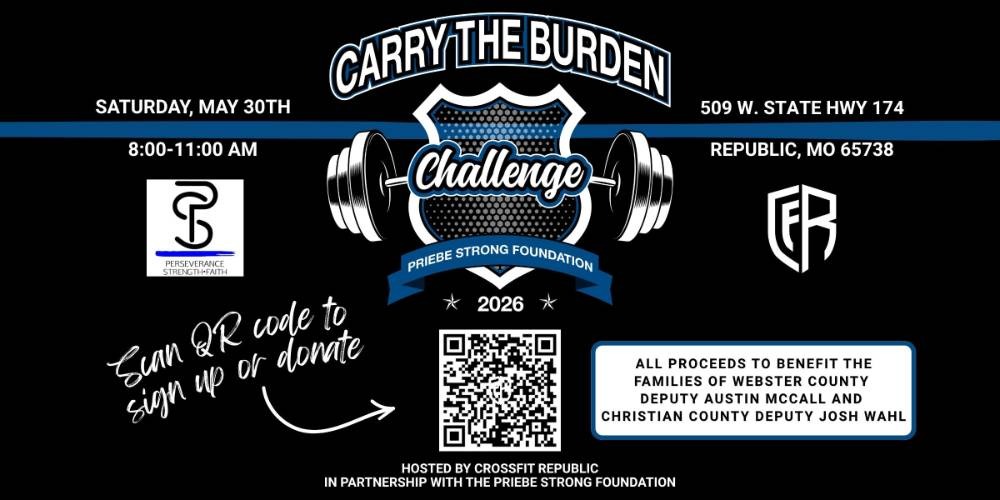
Carry the Burden Challenge 2026 (Checkmark)
We’ve had a huge amount of interest in the Carry the Burden Challenge from people wanting to participate with a spouse, child, friend, or simply support the mission without worrying about fitting neatly into RX or Scaled standards.
Because of that, we’ve officially added an OPEN Division .
This division is for anyone who wants to show up, support the cause, and be a part of the event regardless of fitness level or competitive experience. We have a place for you in this event.
This challenge was never built around competition. It was built around community, remembrance, and supporting first responders and families carrying the burden of service and sacrifice.
This event is also open WELL outside of CrossFit Republic. I’ve personally reached out to several gyms around the area, and if you have friends, coworkers, family members, or athletes from other communities that would want to support an incredible cause, invite them.
Let’s fill the room.
SIGN UP FORM:
What is the Carry the Burden Challenge
DONATION LINK:
Carry the Burden Challenge | Priebe Strong Foundation
Carry the burden with us.
Daily Strength W.O.D. – 12 Minutes (4 Rounds for weight)
Deadlift Cycle – Week 8 – Ancillary Work
Barbell Good Mornings (From the Rack)
4 Sets of 10 Reps
Intended Stimulus
This is a posterior chain accessory movement designed to strengthen the muscles responsible for:
Maintaining position in the deadlift
Hip extension
Spinal stability under load
This is not a max loading exercise.
The goal is controlled tension through the:
Hamstrings
Glutes
Erectors
Why Good Mornings Matter for Deadlifts
A lot of deadlift breakdowns come from:
Losing torso position
Weak posterior chain endurance
Inability to stay hinged under fatigue
Good mornings directly train:
Hip hinge mechanics
Bracing while bent over
Upper and lower back endurance
This carries over into:
Deadlifts
Cleans
Squats
Olympic lifting positions
Execution Notes
Bar stays high and tight on the upper back
Soft bend in the knees
Push hips back, not down
Chest stays proud
Maintain a neutral spine
The torso lowers because the hips move backward.
Range of Motion
Lower until:
Hamstrings are loaded
Position can still be maintained
Back remains neutral
Deeper is not better if position disappears.
Bracing & Midline
Before every rep:
Big breath into the stomach
Brace the torso
Keep tension throughout the hinge
Do not relax at the bottom.
Loading Guidance
Moderate weight
Controlled tempo
Smooth reps throughout all 4 sets
You should feel muscular fatigue, not spinal instability.
If the back rounds or the hinge disappears, reduce the load.
Common Errors
Turning the movement into a squat
Bending excessively through the knees
Losing upper back tension
Hyperextending at the top
Descending too fast without control
Final Thoughts
If you feel this mostly in your lower back and not your hamstrings and glutes, your hinge mechanics are probably off.
()
Daily Conditioning W.O.D. – 15 Minutes (Time)
6 Rounds For Time…
24 Kettlebell Swings (53/35)
12 Burpees to Target
*Burpee target is 6 inches above fingertips with arms overhead.
Intended Stimulus
This is a high-heart-rate conditioning workout with repeated hinging and full-body floor-to-standing movement.
Kettlebell swings tax:
Posterior chain
Grip
Breathing
Burpees elevate:
Heart rate
Recovery demand
Shoulder fatigue
The goal is to maintain:
Consistent movement
Sustainable pacing
Efficient transitions
for all 6 rounds.
Time Domain Breakdown
Kettlebell Swings (24)
:45 – 1:30
Burpees to Target (12)
:45 – 1:30
Round Expectation
Per round: 1:45 – 3:00
Goal pace:
Fast: 10–12 minutes
On pace: 12–15 minutes
If rounds start drifting over 3 minutes early, adjust the swing weight or pace.
Movement Notes
Kettlebell Swings
Hips drive the bell
Arms stay relaxed
Bell moves directly overhead
Maintain a neutral spine
This is a hinge movement, not a squat and front raise.
Burpees to Target
Stay low and efficient
Small controlled jump to the target
Fully extend through hips before touching overhead
The target standard matters:
Arms fully overhead
Clear touch above fingertips
Pacing Strategy
Round 1 should feel controlled
Keep swings smooth and repeatable
Don’t sprint burpees unless you can sustain it
This workout punishes aggressive early pacing quickly.
Common Mistake
Muscling the kettlebell with the shoulders instead of driving with the hips.
That usually leads to:
Grip fatigue
Shoulder burnout
Slower burpees later
Final Thoughts
If your breathing never settles after the burpees, your swing pace is probably too aggressive so consider having a plan ahead for how you’ll break those up.
Step 1:
4 Rounds of…
18 Kettlebell Swings (25/15)
12 Burpees
Step 2:
5 Rounds For Time…
24 Kettlebell Swings (35/20)
12 Burpees to Target
Step 3:
6 Rounds For Time…
24 Kettlebell Swings (35/20)
12 Burpees to Target
Step 5: 70/55