
CrossFit Republic – CrossFit
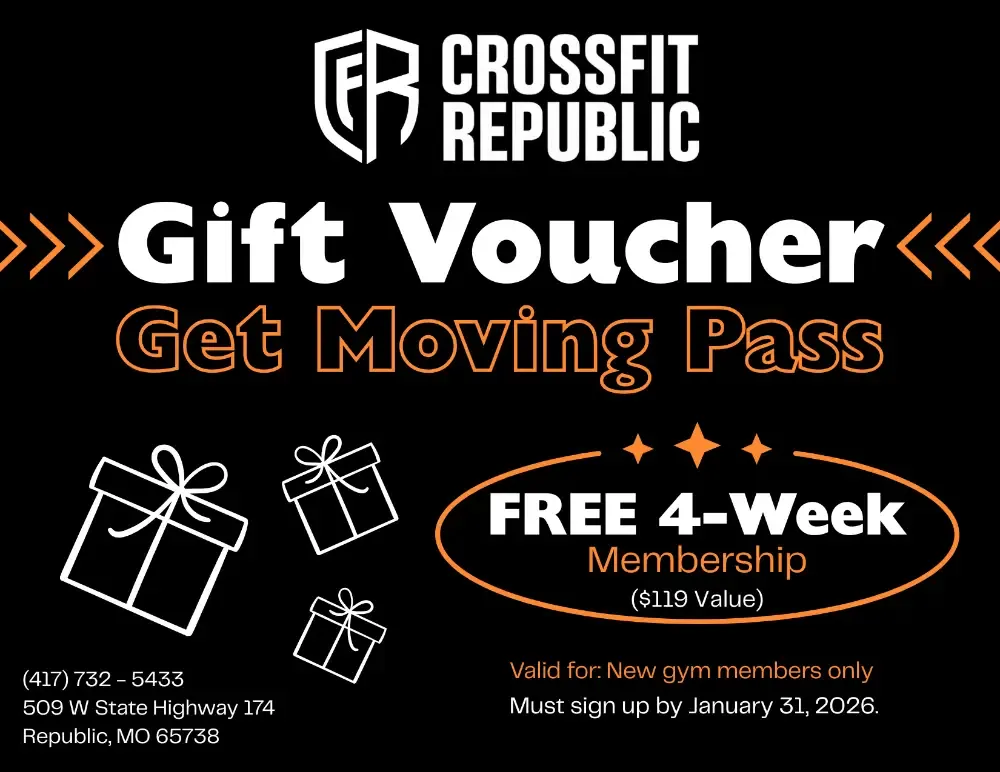
Need a FREE Last Minute Gift for Someone???
These gift vouchers are at the front desk still and they’re 100% free. These DO NOT require purchase. Just a way for you all to cover down on a gift that holds a value of $119 while helping us generate some leads so we can keep growing and investing into this community.
Daily Strength W.O.D. – 20 Minutes (10 Rounds for weight)
Wave 1:
Minutes 0 – 2: 72% x 3
Minutes 2 – 4: 77% x 2
Minutes 4 – 6: 82% x 1
Wave 2:
Minutes 6 – 8: 77% x 3
Minutes 8 – 10: 82% x 2
Minutes 10 – 12: 84% x 1
Wave 3:
Minutes 12 – 14: 82% x 2
Minutes 14 – 16: 87% x 1
Minutes 16 – 18: 92% x 1
Minutes 18 – 20: Heavy single x 1
Today is week 9 of our power clean/squat clean cycle. I wanted to put together some coaching notes for those who are interested in really dialing in these seemingly complicated lifts.
Both lifts start the same way — it’s about how high you’re able to pull the bar and how fast you can get underneath it that determines whether it’s a power or a squat clean.
1. Setup
Before you move the bar, everything starts with how you set up.
Feet under your hips , not too wide.
Think “jump stance” — how you’d naturally land if you jumped straight up.
Hands just outside your legs.
The bar should be close enough that your shins almost touch it.
Back tight, chest tall.
You want to feel your lats (the big muscles under your armpits) pulling the bar in toward your body. If the bar drifts away from you, you lose power — imagine you’re trying to “drag” it up your body like you’re zipping up a jacket.
2. The First Pull – Stay Patient Here
This is where a lot of people rush.
Think: “Push the ground away.”
You’re not trying to rip the bar off the floor or deadlift it up. You’re standing up with it while keeping it close.
Your chest and hips rise together — don’t let your butt shoot up first. If you do, you’ll end up in a bad position for the next phase.
3. The Second Pull – Power Position
This is where the speed and power occur — the bar passes your knees and gets to your thighs.
The bar stays close the whole time, and as it reaches mid-thigh, you drive hard through your legs and shrug tall .
Think: “Jump and shrug.”
You’re not pulling the bar up with your arms — you’re using your legs and hips to launch it upward, and your arms just guide it. When you do it right, the bar should feel like it wants to float for a split second.
4. The Turnover or Third Pull – Fast Elbows
This is all about speed and precision.
The moment you feel that bar “float,” snap your elbows around fast and meet it with your shoulders , not your hands.
Think: “Elbows to the ceiling.”
5. The Catch – Power vs. Squat
Here’s where the two versions split:
Power Clean: You catch it above parallel — hips stay higher, like a strong athletic position.
Squat Clean: You catch it below parallel — full squat, elbows up, bar resting on the shoulders.
If you’re pulling heavy and can’t catch it high anymore, you pull yourself under into the squat.
6. The Finish – Stand Tall
No matter what, the lift isn’t done until you’re standing tall with the bar, elbows high, and feet under you. That’s your clean.
Every part of the clean builds off the one before it.
If your setup is tight and your first pull is patient, the rest of the lift feels like it happens naturally.
If you rush the beginning or try to muscle it up, you’re fighting physics the whole way.
Power Clean (Weightlifting Variable Reps & Sets)
Squat Clean (Weightlifting Variable Reps & Sets)
Daily Conditioning W.O.D. – 8 Minutes (Time)
For Time…
“Grace”
30 Clean and Jerks (135/95)
Step 1: 75/55
Step 2: 95/65
Step 3: 115/85
Beginner athletes may consider going from the hang if they’re struggling with the mechanics of coming from the ground. Masters the leg and hip drive first while keeping the arms locked and long with a neutral spine. Once you nail this, you’ll be surprised with how much weight you’re capable of moving.
Intended Stimulus
“Grace” is designed to be short, heavy, and uncomfortable .
This is not a strength test and not a long grind. It’s a high-power output sprint that demands you move a moderately heavy barbell fast, repeatedly, and under fatigue .
Time Domain
Elite: 1:30–2:30
Advanced: 2:30–4:00
Most athletes: 4:00–7:00
Load and movement must be adjusted to keep this under 10 Minutes
Loading
The barbell should feel heavy but repeatable .
Singles should be fast and confident.
You should never question whether you can stand the bar up.
Touch-and-go reps are possible early, but not required.
Movement Standard
Clean should be efficient and consistent (power or squat is fine).
Jerk should be automatic—no grinding presses.
The limiting factor should be breathing and turnover speed , not maximal strength.
Primary Limiter
Anaerobic capacity and barbell cycling efficiency.
Grip, lungs, and midline fatigue accumulate quickly.
Poor pacing shows up immediately.
Pacing Expectation
The goal is to start controlled and stay aggressive .
Big early sets are fine if technique stays sharp.
Short, planned breaks beat reactive rest.
What Success Looks Like
Smooth reps with minimal hesitation.
The bar leaves the floor quickly every time.
You feel wrecked at the end—but never stuck.
Scaling Guideline
Scale to a load that allows:
Fast singles or small sets
No failed reps
Completion within the intended time domain
Grace rewards athletes who respect the barbell, move with urgency, and manage discomfort without hesitation.
Grace (Time)
For Time:
30 Clean and Jerks, 135# / 95#