
CrossFit Republic – CrossFit
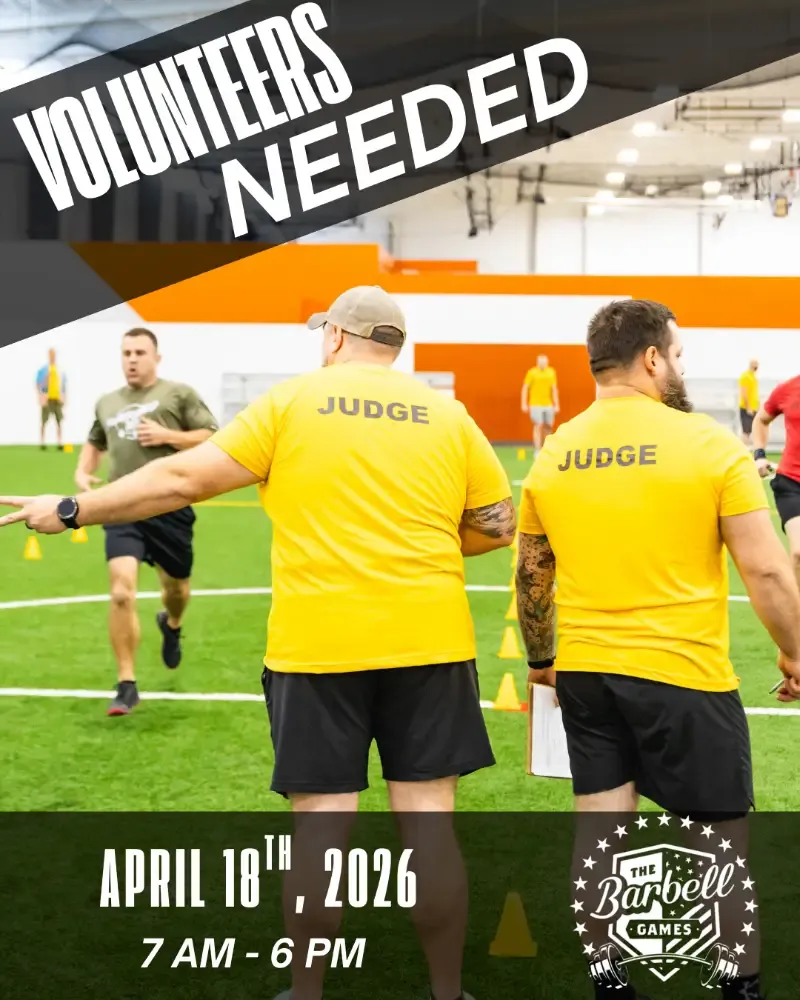
Volunteers Needed!
Volunteer Form Here
Volunteers Needed – Barbell Games Team Fitness Competition
We’re looking for volunteers to help us deliver a smooth, professional competition at The Barbell Games.
We need support in:
• Judging
• Reset Crew
• Set-Up / Load-In
• Load-Out
All volunteers receive a shirt, swag bag, meal vouchers, snacks, and drinks (non-alcohol for those that will ask me) during their shift.
The Science Behind Negatives with Supramaximal Loads
The Big Idea
Humans are stronger eccentrically than concentrically (you can lower more than you can lift).
Negative training takes advantage of this by exposing the nervous system and muscles to supra-maximal loads safely.
This creates adaptations you simply cannot get from normal lifting alone.
1) Eccentric Loading Produces Greater Strength Gains
One of the most consistent findings in strength research:
Eccentric training produces greater increases in maximal strength than concentric training.
Why:
Higher force production possible
Greater motor unit recruitment
Higher mechanical tension per rep
Key research:
Roig et al., 2009 meta-analysis (Journal of Applied Physiology)
→ Eccentric training produced greater strength increases than concentric-only training.
What this means for athletes:
Heavy negatives teach the body to handle heavier loads , which carries over to higher 1RM potential.
2) Improves Neural Drive & Confidence With Heavy Loads
Heavy negatives improve the nervous system’s ability to:
Recruit high-threshold motor units
Coordinate heavy lifting patterns
Reduce neural inhibition around heavy weights
In plain terms:
Your brain stops treating heavy weight as a threat and starts treating it as normal .
This is one of the biggest reasons negatives help break plateaus.
3) Increases Muscle Hypertrophy Through Mechanical Tension
Eccentric contractions create:
More muscle fiber damage
Longer time under tension
Greater anabolic signaling
Research consistently shows eccentrics stimulate:
Higher muscle protein synthesis
Greater hypertrophy signaling
Key research:
Schoenfeld, 2010–2017 body of work on hypertrophy
Douglas et al., 2017 Sports Medicine review on eccentric training
For bench press:
More upper-body muscle = larger strength ceiling.
4) Strengthens the “Sticking Point”
Most bench failures happen:
Off the chest
Mid-range of the press
Heavy negatives specifically strengthen:
Bottom position control
Transition out of the chest
Bar path stability
This is why many powerlifting programs include eccentrics before max testing.
5) Improves Tendon & Connective Tissue Strength
Heavy eccentrics create strong adaptations in:
Tendons
Connective tissue
Joint stability
Research shows eccentric loading is highly effective for:
Tendon stiffness
Injury resilience
This matters for long-term pressing health.
Why This Works Specifically for Bench Press
Heavy negatives improve:
Confidence under heavy load
Upper-back tension control
Stability in the bottom position
Motor unit recruitment
Hypertrophy potential
All of these are major limiters in pressing strength.
The Practical Takeaway
Heavy bench negatives help athletes:
Break plateaus
Handle heavier weights confidently
Build more muscle
Improve tendon durability
Increase future 1RM potential
That’s why they show up in:
Powerlifting programs
Olympic lifting accessory work
Advanced strength cycles
Daily Strength W.O.D. – 15 Minutes (5 Rounds for weight)
Bench Press (Negatives)
3 – 3 – 3 – 3 – 3
3 second decent, followed by spotter pulling the bar back up.
Spotter, ensure you don’t pull so hard that the lifter losing their upper back engagement on the bench.
Set 1: 90 – 95% 1RM
Set 2: 95 – 100% 1RM
Set 3: 100 -105% 1 RM
Set 4: 105 – 110% 1RM
Set 5: 110% – 120% 1RM
Intended Stimulus
This is eccentric strength and positional control work.
The goal is to:
Build strength through the lowering phase
Reinforce upper-back tension under heavy load
Improve confidence handling heavier weights in the bench press
This is not a pressing workout. The work happens on the way down .
Lifter Notes
Same setup as normal bench: feet planted, upper back tight.
Lower the bar under full control for a full 3 seconds .
Maintain tension through the chest, lats, and upper back.
Do not relax at the bottom.
Spotter Notes
Assist just enough to return the bar to the top.
Do not yank the bar off the athlete’s chest.
Help smoothly so the lifter maintains tension and position.
Rest
Take 2–3+ minutes between sets. These should feel heavy and intentional.
Rule of Thumb
If the descent speeds up or you lose upper-back tension, the load is too heavy.
Control matters more than numbers today.
()
Daily Bodybuilding Bro Sesh – 15 Minutes (5 Rounds for weight)
Every 3 Minutes on the 3 Minutes for 5 Rounds Complete…
12 – 15 Double Dumbbell Lateral Raises
12 – 15 Double Dumbbell Front Raises
12 – 15 Double Dumbbell Upright Rows
Same dumbbells across the entire round. Stay at the same weight or build as you go.
Intended Stimulus
This is shoulder health and structural strength work , not conditioning.
The goal is to build the smaller muscles of the shoulder so they can support the bigger lifts and high-volume overhead work we do regularly.
Expect a controlled pace and a strong burn in the shoulders by the end of each round.
Why This Matters for CrossFit & Strength Training
CrossFit athletes spend a lot of time:
Overhead (snatches, jerks, presses, handstand work)
Hanging (pull-ups, toes to bar, muscle-ups)
Catching load dynamically (cleans and snatches)
All of that relies heavily on the rotator cuff and smaller shoulder stabilizers .
These muscles don’t produce big force, but they keep the shoulder joint stable while the larger muscles do the work.
Without targeted work like this:
Overhead positions become less stable
Pressing strength plateaus sooner
Injury risk increases as training volume rises
This type of training helps:
Improve shoulder stability and control
Support long-term pressing and overhead strength
Increase durability for high-volume gymnastics and barbell work
Balance the large amount of pushing and pulling we do in training
Think of this as maintenance and reinforcement so the bigger lifts can keep progressing.
Execution Notes
Light to moderate dumbbells.
Controlled tempo.
No swinging or torso movement.
If you have to use momentum, the weight is too heavy.
If this feels like conditioning, you chose weights that are too heavy.
This is about quality shoulder work , not intensity.
Endurance W.O.D. – 30 Minutes (Time)
2 Rounds For Time (One Time Through What you See Written Below is a Round)…
30/24 Calorie Row
30 Burpees
30/24 Calorie Echo Bike
Rest 3 Minutes
30/24 Calorie Echo Bike
30 Burpees
30/24 Calorie Row
Rest 3 Minutes
Burpee Standard: You must stand to full extension and clap your hands above your head. See video below. Disregard the “push up.” You do not have to slowly lower and raise yourself from the floor; however, you will stand up all the way. Coaches, hold the line even if it results in some sad faces.
Step 1 — Beginner
2 Rounds For Time
18/14 Calorie Row
20 Burpees
18/14 Calorie Bike
Rest 3:00
18/14 Calorie Bike
20 Burpees
18/14 Calorie Row
Rest 3:00
Intent:
Simple, sustainable engine work. Lower volume so athletes can keep moving without extended rest.
Step 2 — Scaled
2 Rounds For Time
24/20 Calorie Row
25 Burpees
24/20 Calorie Bike
Rest 3:00
24/20 Calorie Bike
25 Burpees
24/20 Calorie Row
Rest 3:00
Intent:
Slightly more volume, still manageable pacing. Athletes should finish each round without redlining.
Step 3 — Intermediate
2 Rounds For Time
27/21 Calorie Row
30 Burpees
27/21 Calorie Bike
Rest 3:00
27/21 Calorie Bike
30 Burpees
27/21 Calorie Row
Rest 3:00
Intent:
Matches the full structure and flow. Fatigue is noticeable but controllable. This should feel challenging without chaos.
Big Picture (Across All Steps)
This is an engine-first workout
Burpees are the limiter, not strength
The rest periods are there to allow two hard, honest efforts, not survival pacing
If round two falls apart completely, the step was too aggressive.