
CrossFit Republic – CrossFit
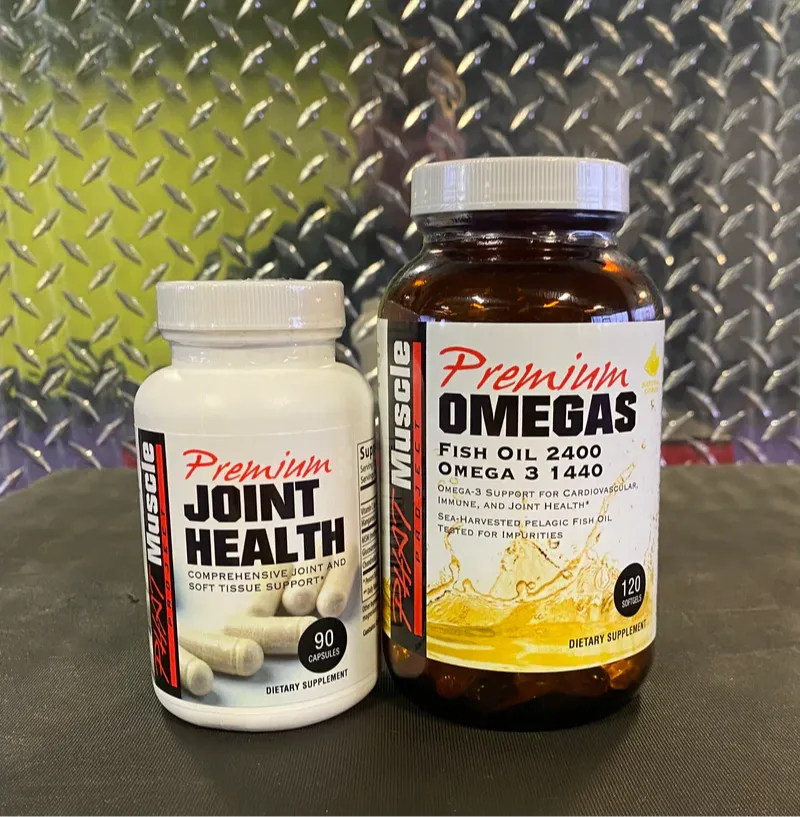
Stiff or Sore Joints? Read This!
Most people don’t think about joint health until something hurts and that’s backwards.
If you train consistently in any resistance style training, you’re putting repeated stress on joints, tendons, and connective tissue. The goal isn’t just to recover from that stress. It’s to support the system before it breaks down .
Here’s where supplementation can actually make sense.
Omega-3 Fish Oil
Omega-3s (EPA + DHA) help regulate inflammation and not totally eliminate it.
Training creates inflammation. That’s part of the adaptation process. But when it becomes excessive or chronic, it starts working against you:
Joint stiffness
Lingering soreness
Slower recovery
Omega-3s help bring that back into balance which means that:
Less unnecessary joint irritation
Better recovery between sessions
More consistency in training
Joint Health Supplement
These typically include ingredients like:
Glucosamine
Chondroitin
MSM
Their role is structural support. They don’t act like a painkiller. They work over time by:
Supporting cartilage health
Improving joint lubrication
Reducing wear and tear
These ingredients for for maintenance , not a quick fix.
If you’re lifting, running, jumping, or doing high-rep gymnastics, this is where joint support matters most.
Collagen
Collagen is totally different from Omega 3s and Joint Health Supplements.
It directly supports:
Tendons
Ligaments
Connective tissue
These are the structures that take the most abuse in training and the slowest to recover .
Supplementing collagen (especially with vitamin C) gives your body the building blocks it needs to:
Strengthen connective tissue
Improve resilience
Potentially reduce injury risk over time
How All Three of These Work Together
Each one does something different:
Fish oil controls inflammation
Joint supplement supports the joint itself
Collagen strengthens the connective tissue around it
You’re not doubling up or trippling up, you’re actually covering different pieces of the same system .
Bottom Line is that y ou don’t need supplements to train hard.
But if you’re:
Training 4–6 days a week
Dealing with nagging joints
Wanting to stay consistent long term
Then supporting your joints isn’t optional, it’s responsible.
And if you’re going to take something, don’t just grab the cheapest option on a shelf.
Know what it does, use it consistently and give it time to work.
Daily Strength, Conditioning, and Endurance W.O.D. – 30 Minutes (6 Rounds for time)
Every 5 Minutes for 6 Sets Complete…
Set 1 (0:00 – 5:00): 60 Front Rack Stationary REVERSE Lunges (115/85) (R/L=2)
Set 2 (5:00 – 10:00): 50/40 Calorie Row
Set 3 (10:00 – 15:00): 30 Bar Facing Burpees
Set 4 (15:00 – 20:00): 60 Front Rack Stationary REVERSE Lunges (115/85) (R/L=2)
Set 5 (20:00 – 25:00): 50/40 Calorie Row
Set 6 (25:00 – 30:00): 30 Bar Facing Burpees
Score is time to complete each set. Log all 6 times.
Intended Stimulus
This is a repeatable interval conditioning workout with three distinct demands:
Unilateral leg strength under load (lunges)
Sustainable engine output (row)
Bodyweight conditioning under fatigue (burpees)
Each station repeats twice, giving you a chance to adjust pacing and improve execution on the second exposure.
The goal is to complete each set within the window and earn rest , not to barely finish or miss the cap.
Time Targets
Lunges: 3:00–4:00
Row: 2:30–3:30
Burpees: 2:00–3:00
You should have at least :30–1:30 of rest each interval.
If you are consistently finishing right at 5:00, scaling is appropriate.
How This Should Feel
Lunges: controlled but taxing on legs and midline
Row: steady and uncomfortable
Burpees: consistent, not frantic
Second round of each movement should feel harder, but still manageable.
Movement Notes
Front Rack Reverse Lunges
Stay tall with elbows high
Step back under control
Light touch of the back knee
Drive through the front leg
Break early if needed to avoid long rest later.
Row
Strong, consistent pace
Avoid sprinting the first set
Match or slightly improve pace in the second set
Bar Facing Burpees
Smooth and repeatable
Two-foot takeoff and landing
Stay low and efficient over the bar
Pacing Strategy
Set 1–3: establish sustainable pace
Set 4–6: match or slightly improve output
If you blow up early, the second half becomes survival.
Big Picture
This workout trains:
Repeatable interval output
Lower-body stamina under load
The ability to recover and perform again
Finish each set with time to rest. That’s the standard.
Step 1:
40 Front Rack Reverse Lunges (45/35) or 40 Double Dumbbell Reverse Lunges (25s/15s)
30/24 Calorie Row
20 Bar Facing Burpees
Step 2:
50 Front Rack Reverse Lunges (75/55)
40/32 Calorie Row
30 Bar Facing Burpees
Step 3: 95/65
Step 5: 135/95